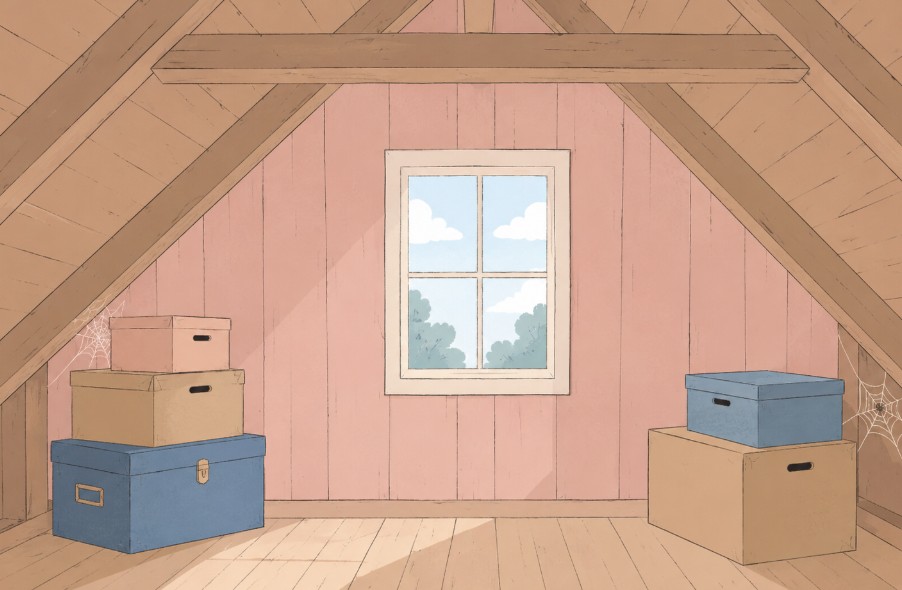
I own twice as many things as I need, and I am currently sorting through all of it.
I remarried a year ago. My husband and I have kept separate homes while my daughter finished high school, because I had the house in her school district. She graduates next week (cue the waterworks), and we are finally combining two households into one (cue the celebration). The work of deciding what stays and what goes has been a real chore, and it has taught me something about organizations.
I have done this many times. Over twenty years I have moved every five to seven years, so I have developed a practiced sense of what is worth keeping. My husband has been in his house for more than a decade, and his decluttering is taking more time than mine. Part of it is tenure. Nothing has required him to examine what he owns. But part of it is his disposition. He keeps things because he might need them one day. Each item has a plausible future use, so nothing quite qualifies for the discard pile. Things accumulate when no force acts to remove them, and they accumulate faster when the owner can imagine a reason to hold on to them.
Organizations work the same way, and they reason the same way. Programs, processes, and assumptions build up over years, and often are never deliberately reviewed. A new leader inherits all of it at once and has to figure out what is there. There are roughly three things you might find.
The first is the pile of dust-covered programs that should have ended long ago and never did. It still consumes budget and staff time. No one ends it, because someone can always argue it has some use even if that use was a decade ago. That is the organizational version of keeping the thing in case you need it one day, and it is just as effective at filling an attic.
The second is the empty box. This is a process everyone refers to as if it were established and documented, but when you open it to understand how it actually works, there is nothing inside. The knowledge lived in one person’s head, or it left when someone retired, and no one recorded it. The label is real. The contents are gone.
The third is the well-kept space, where procedures are documented and handed over in good order. This is the product of people who treated documentation as part of the work rather than an afterthought.
At APS I have found mostly the third, which I do not take for granted. But I am also finding empty boxes. I will ask how a particular thing is done and learn that the answer was never written down, that it depended entirely on a person who is no longer in the role. Each empty box is a small risk that was invisible until I went looking.
The deeper point is about discipline. You do not need a move to clear out a house, and you do not need a leadership transition to retire a failing program or document how something is done. The maintenance can happen continuously. But it usually does not, because the work of clearing out is never the most pressing thing in front of you. It competes with the immediate, and the immediate almost always wins. So the accumulation continues quietly until some external event forces the reckoning that steady discipline would have made unnecessary.
The move is making me confront what I had been carrying in my personal life. A new role is making me ask what this organization has been carrying. Neither reckoning had to wait for the forcing event, but both has.




Leave a comment