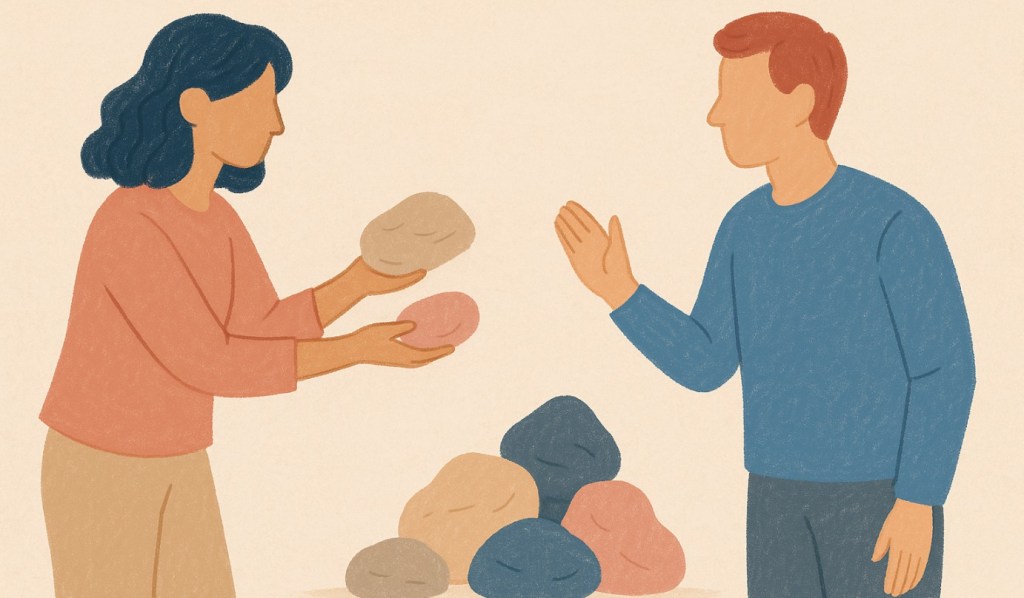
If you’ve ever worked for a client, boss, or board who keeps changing what they want or who doesn’t know how to explain what they want, then you’ve probably found yourself carrying rocks.
You bring them a rock you think that will like—a deliverable, a plan, a design—and they say, “That’s not quite it.” So you go and get a different rock. One that is shinier. You bring it back, and they still say, “Hmm, not quite.” Before long, you’ve lugged half a quarry trying to find the perfect rock.
This endless back-and-forth isn’t really about rocks. It’s about alignment.
Shifting from Reaction to Collaboration
When I feel a “rock-carrying exercise” coming on, I turn to what I call the toddler’s dilemma. When my kids were toddlers, I learned that open-ended questions lead to chaos. If I said, “Put on a shirt,” we could spiral into a morning meltdown. But if I said, “Do you want the green shirt or the red one?” then we had a path forward.
The key was giving options within a shared frame. It wasn’t about control; it was about focus.
How This Works in Practice
If a project’s scope is unclear or the decision-maker is uncertain, I don’t show up with one idea. I show up with two.
Two potential designs.
Two project scopes.
Two budget models.
Sometimes they pick one. Sometimes they land on something in between. Either way, we’re aligned early and moving toward clarity instead of circling frustration.
This simple shift to framing choices rather than defending options, has saved me hours of rework and built trust in every kind of setting: strategy sessions, board discussions, even website redesigns.
Getting Out of the Rock Quarry
When the situation feels vague:
- Start broad, but not blank. Don’t ask “What do you want?” Instead offer two contrasting but reasonable directions.
- Invite refinement, not rejection. Position your options as starting points, not final answers. You don’t want to do this with final products or you will do double the work. You need to get the input early in the process.
- Name the goal out loud. Remind everyone what the rock is supposed to achieve.
We have all had a time when we were hauling rocks up a hill, hoping the next one is “right.” When you replace open-ended guessing with structured choices, you stop carrying rocks and start building something together.
What about you—how do you handle projects when the scope is vague and the client uncertain?



Leave a comment